
Dimethicone Conditioner: Benefits, Uses, Chemical Structure, and Formulation Guide
2026-10-17
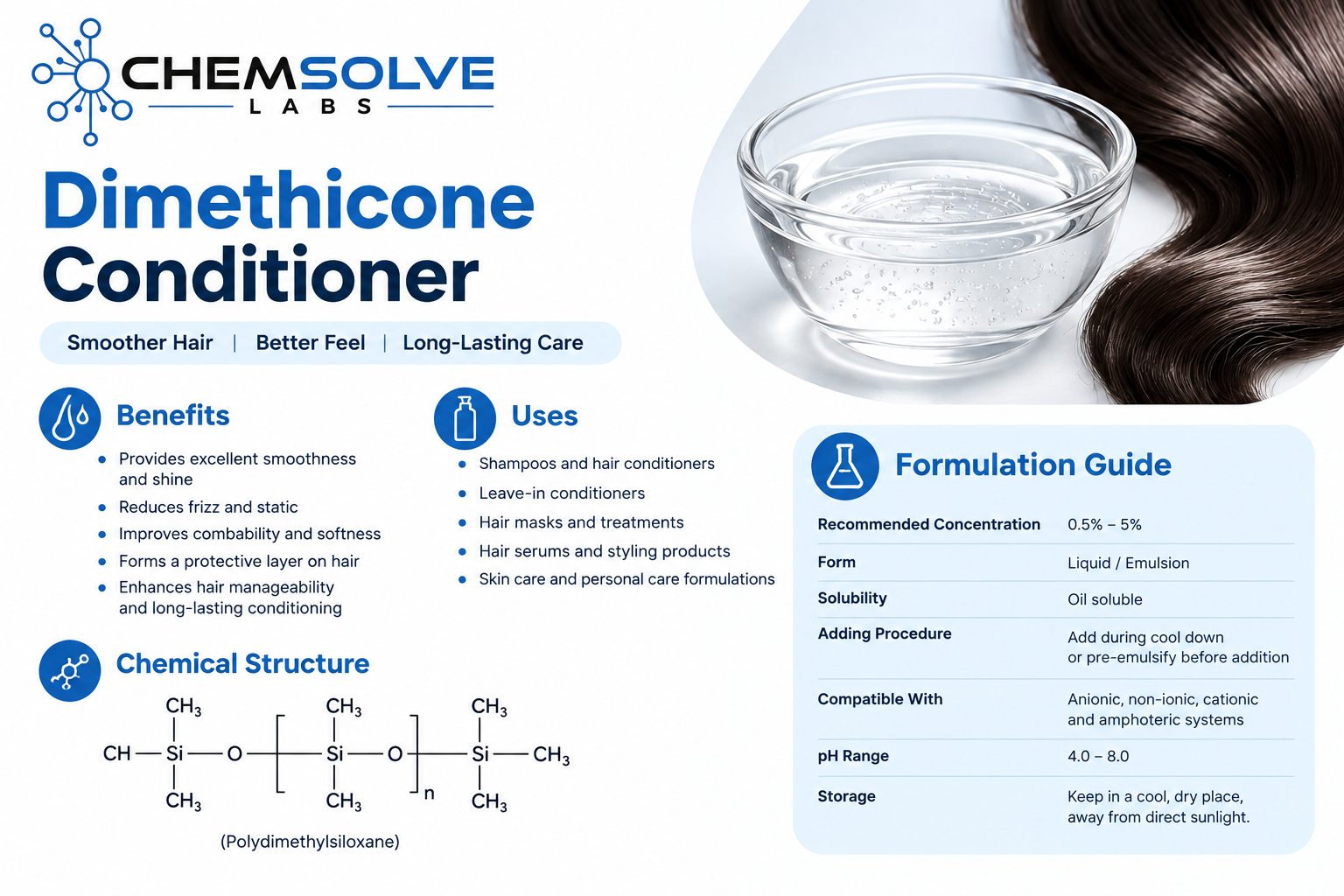
Dimethicone Conditioner
Dimethicone is one of the most widely used silicone ingredients in the hair care and personal care industries. It is valued for its ability to improve hair smoothness, softness, shine, and manageability.
Dimethicone is commonly used in shampoos, hair conditioners, leave-in conditioners, hair masks, hair serums, and styling products to provide conditioning benefits and reduce friction between hair fibers. Unlike conventional oils, dimethicone is a silicone-based polymer that forms a thin, lubricating film on the hair surface. This film helps improve the sensory properties of hair without requiring large quantities of oily ingredients.
In shampoo formulations, dimethicone helps reduce combing friction and improve the feel of hair after rinsing. In hair conditioners, it provides enhanced lubrication, smoothness, shine, and frizz control. Understanding its chemical structure, compatibility, concentration, and incorporation procedure is essential for developing stable and effective hair care products.
What Is Dimethicone?
Dimethicone is a synthetic silicone polymer belonging to the organosilicon compound family. Its chemical structure consists of a repeating backbone of alternating silicon and oxygen atoms, with methyl groups attached to the silicon atoms.
Its INCI name is Dimethicone, and it is also commonly known as polydimethylsiloxane or PDMS. The CAS number commonly associated with dimethicone is 9006-65-9. Depending on the grade, dimethicone is available as a clear, colorless liquid with viscosities ranging from very low to extremely high.
It is generally insoluble in water and is primarily used as a hair-conditioning agent, lubricant, smoothing agent, and shine enhancer. Because dimethicone is hydrophobic, it does not readily mix with water and usually requires an appropriate emulsification or dispersion system when incorporated into water-based shampoos and conditioners. The selection of the correct grade depends on the product type, desired conditioning performance, viscosity requirements, and compatibility with other ingredients.
Chemical Structure of Dimethicone and its Selection as Conditioner
The general repeating structural unit of dimethicone is represented as [–Si(CH₃)₂–O–]ₙ, while a simplified representation of a trimethylsiloxy-terminated chain is CH₃–[Si(CH₃)₂–O]ₙ–Si(CH₃)₃. The exact molecular structure and terminal groups depend on the particular silicone grade. The silicon–oxygen backbone forms a flexible polymer chain that contributes to the spreading and lubricating properties of dimethicone. Methyl groups attached to the silicon atoms provide hydrophobic characteristics and contribute to its low surface energy.
The polymer chain length and molecular weight influence the viscosity, spreading behavior, film formation, and sensory characteristics of the ingredient. Lower-viscosity grades generally spread more easily and may produce a lighter sensory effect, whereas higher-viscosity grades can provide a more substantial lubricating film but may be more difficult to disperse. The final performance also depends on the delivery system, concentration, hair type, and other conditioning ingredients present in the formulation.
Benefits of Dimethicone for Hair
Dimethicone provides several benefits in hair care formulations because of its lubricating and film-forming properties. One of its primary benefits is improving hair smoothness by reducing friction between individual hair fibers. This can make hair feel softer and more manageable, particularly when it is dry, rough, damaged, or chemically treated.
Dimethicone can also enhance hair shine by improving the smoothness of the hair surface and influencing light reflection. This makes it a valuable ingredient in shine-enhancing shampoos, conditioners, and hair serums. Another important benefit is reduced combing friction. Wet hair is particularly vulnerable to mechanical stress during brushing and combing, and the lubricating film provided by dimethicone can reduce the force required to move a comb through the hair. This may help minimize friction-related damage during grooming.
Dimethicone is also useful for controlling frizz because it smooths the hair surface and reduces friction between hair fibers. Although it does not permanently straighten hair or change its internal structure, it can improve the appearance of frizzy hair and make styling easier. Its conditioning properties contribute to a soft, silky after-feel that consumers often associate with premium hair care products. Dimethicone can also help improve hair manageability, making hair easier to detangle, comb, and style. In addition, its lubricating film may reduce mechanical stress during brushing and styling.
However, the degree of conditioning depends on the silicone grade, concentration, deposition efficiency, formulation composition, and frequency of use. Excessive deposition may make some hair types feel coated or heavy, so the concentration should be optimized for the intended consumer and product application.
Uses of Dimethicone in Hair Care Products
Dimethicone is used in several types of hair care products, including conditioning shampoos, rinse-off conditioners, deep-conditioning masks, leave-in conditioners, hair serums, styling creams, and certain heat-styling products.
In conditioning shampoos, it helps improve softness, smoothness, and combability after rinsing. In rinse-off conditioners, it provides lubrication, detangling, shine, and a silky after-feel.
In deep-conditioning masks, it can contribute to a more substantial conditioning effect, depending on the silicone grade and concentration. In leave-in conditioners, dimethicone helps improve manageability and reduce the appearance of frizz without requiring rinsing.
In hair serums, it is frequently used to enhance shine and provide surface lubrication. Certain silicone systems are also incorporated into styling products to improve spreading and reduce friction during styling.
However, the use of dimethicone in heat-protection products does not automatically establish heat-protection performance; such claims require appropriate testing of the finished formulation. Different silicone ingredients are not interchangeable, so the selected grade should match the intended application, formulation requirements, and supplier recommendations.
Recommended Concentration of Dimethicone
The recommended concentration of dimethicone depends on the type of hair care product, the viscosity of the silicone, the delivery system, and the desired sensory performance.
As an initial laboratory-development guide, conditioning shampoos may contain approximately 0.2–1.0% active dimethicone, while rinse-off conditioners may contain approximately 0.5–3.0%. Deep-conditioning masks may use approximately 1.0–4.0%, and leave-in conditioners may use approximately 0.2–2.0%.
Hair serums may contain approximately 1.0–10.0% or more, depending on the complete formulation and whether dimethicone is used alone or with other silicone fluids. These are practical starting ranges rather than universal industry standards, regulatory limits, or guaranteed performance levels.
Higher concentrations can increase lubrication and shine, but they may also make the hair feel heavy or reduce volume. The final concentration should be established through laboratory testing and consumer-use evaluation.
It is important to distinguish between active dimethicone and a commercial silicone emulsion. Dimethicone may be supplied as a neat silicone fluid or as an emulsion containing a specific percentage of silicone. For example, if a formulation contains 1.0% of a commercial silicone emulsion containing 60% dimethicone, the active dimethicone concentration is calculated by multiplying the amount of emulsion by its silicone content. Therefore, 1.0% emulsion multiplied by 60% silicone content provides 0.60% active dimethicone in the finished product. Formulators should always review the supplier's technical data sheet to confirm silicone content, carrier ingredients, recommended dosage, compatibility, and processing instructions before preparing a formulation.
Mechanism of Action of Dimethicone on Hair
Dimethicone primarily works through surface lubrication and film formation. When a dimethicone-containing shampoo or conditioner is applied to hair, a portion of the silicone may deposit on the hair surface, depending on the formulation and application conditions.
In shampoos, deposition is influenced by the silicone dispersion, surfactant system, conditioning polymers, and other ingredients that affect deposition during rinsing. After application, the deposited silicone can form a lubricating film that reduces friction between individual hair fibers.
This improves the movement of hair fibers against one another and can make hair feel smoother, softer, and easier to comb. The film can also improve shine and manageability by influencing the surface properties of the hair. Dimethicone does not biologically repair damaged hair or permanently restore its internal structure. Instead, it improves the surface characteristics of the hair and may help reduce mechanical stress associated with combing and styling.
Professional Cosmetic Formulation Services
Developing a stable shampoo or conditioner requires careful selection of silicone ingredients, emulsifiers, conditioning polymers, and surfactants. If you are experiencing silicone separation, viscosity loss, or compatibility problems, professional formulation support can help identify and resolve these issues.
At ChemSolve Labs, we provide professional Cosmetic Formulation Services including new product development, formula modification, ingredient selection, and formulation troubleshooting.
Explore our New Product Formulation Services to develop your next cosmetic product.