Polyquaternium-7: Benefits, Uses, Chemical Structure, and Formulation Guide
2026-10-23
Introduction to Polyquaternium-7
Polyquaternium-7, commonly known as PQ-7, is a water-soluble, cationic conditioning polymer widely used in cosmetic and personal care formulations. It is particularly popular in shampoos, hair conditioners, body washes, liquid soaps, shaving products, and other cleansing formulations because it improves softness, smoothness, and product sensory performance. Polyquaternium-7 is valued for its ability to reduce static electricity, improve wet-combing performance, enhance foam quality, and leave hair feeling smoother and easier to manage.
Unlike conventional oils and silicone fluids, Polyquaternium-7 is a charged polymer that interacts with negatively charged surfaces, including damaged hair fibers. This interaction helps the polymer deposit on the hair surface, forming a conditioning film that reduces friction and improves manageability. In skin cleansing products, it can provide a smoother, softer after-feel and help reduce the harsh sensory effect associated with some surfactant systems. For cosmetic chemists and product developers, Polyquaternium-7 is a versatile ingredient for improving the performance of shampoos, conditioners, shower gels, and liquid cleansing products.
1. What Is Polyquaternium-7?
Polyquaternium-7 is a synthetic cationic copolymer produced from acrylamide and diallyldimethylammonium chloride, commonly abbreviated as DADMAC. Its INCI name is Polyquaternium-7, and its commonly listed CAS number is 26590-05-6. It belongs to the polyquaternium family of conditioning polymers used in personal care products. Commercial Polyquaternium-7 is commonly supplied as a clear to slightly yellowish, viscous aqueous solution. The exact appearance, viscosity, pH, and active polymer content depend on the supplier and commercial grade. Many cosmetic grades contain approximately 8–10% polymer solids, although other grades may have different concentrations.
Polyquaternium-7 is water-soluble and can generally be incorporated into aqueous cosmetic formulations without requiring a separate oil phase. It is frequently used in surfactant-based products because it can provide conditioning benefits while maintaining compatibility with many anionic, amphoteric, and nonionic surfactant systems. However, compatibility should always be verified using the technical data sheet for the selected grade.
2. Chemical Structure of Polyquaternium-7
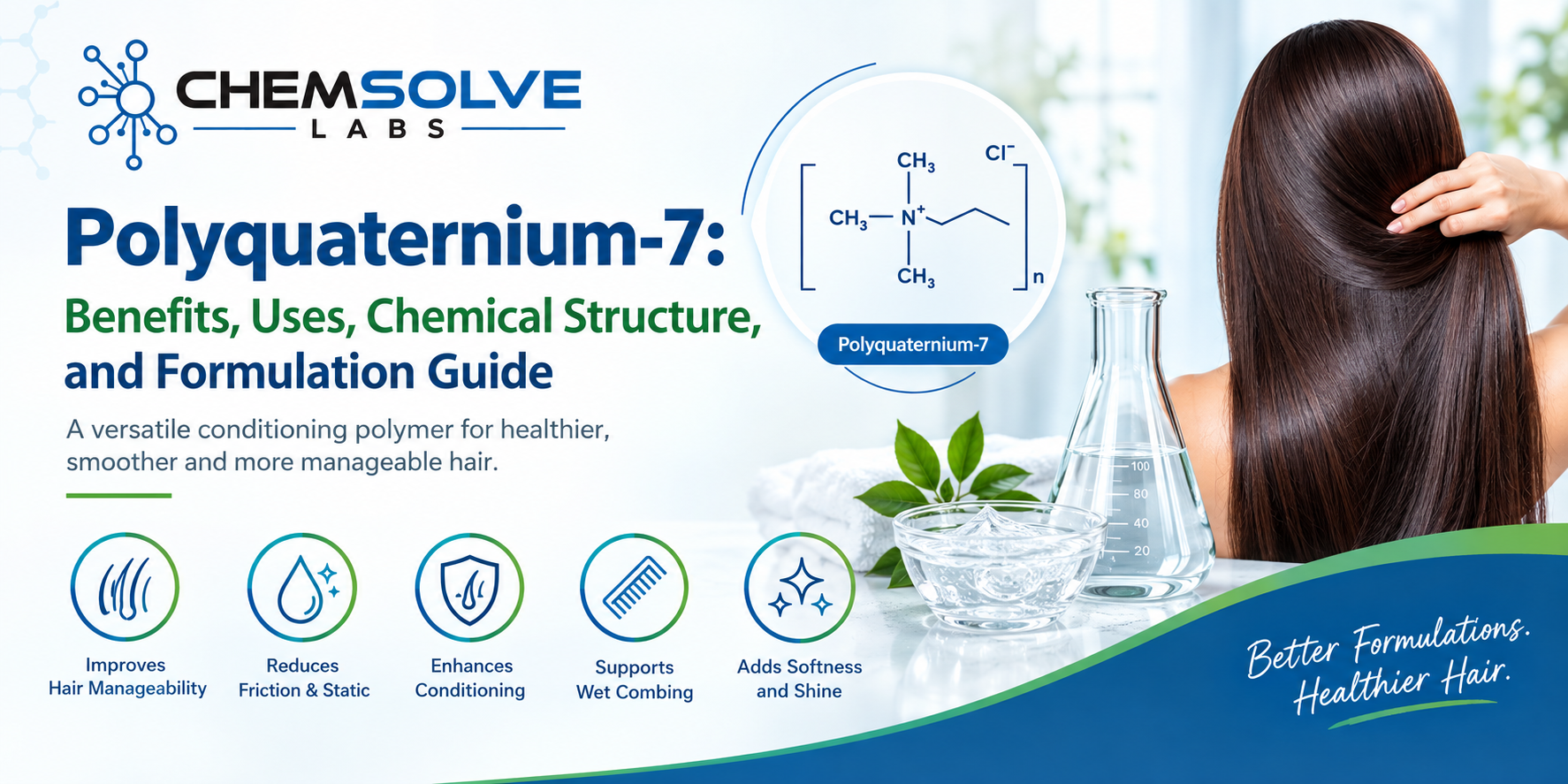
Polyquaternium-7 is a copolymer of acrylamide and diallyldimethylammonium chloride. Its polymer structure contains acrylamide-derived units and permanently charged quaternary ammonium groups associated with the DADMAC-derived units. The acrylamide-derived portions contribute to the polymer backbone and its physical properties, while the quaternary ammonium groups provide the positive charge responsible for its cationic conditioning behavior. Unlike a small molecule with a single fixed structural formula, Polyquaternium-7 is a polymer consisting of repeating units. Its exact molecular architecture, molecular weight distribution, and relative proportions of the comonomers depend on the manufacturing process and commercial grade. The positive charge is particularly important because hair often develops a negative surface charge, especially when damaged by bleaching, coloring, heat styling, or repeated washing. The cationic nature of Polyquaternium-7 promotes interaction with these surfaces, supporting polymer deposition and conditioning.
3. Key Properties of Polyquaternium-7
Polyquaternium-7 is primarily valued for its cationic character, water solubility, film-forming behavior, and conditioning performance. Commercial grades are usually supplied as viscous liquids rather than dry powders, making them relatively convenient for use in aqueous formulations. Its positive charge supports deposition on negatively charged hair surfaces, while its polymeric structure contributes to lubrication and film formation. These properties help improve wet-combing performance, reduce static electricity, and enhance the smoothness of hair after washing. Polyquaternium-7 can also improve the sensory properties of skin cleansing products by providing a softer and smoother after-feel. In surfactant systems, it may influence foam texture and stability, producing a richer or creamier lather depending on the formulation.
Its performance depends on polymer concentration, active solids, molecular characteristics, surfactant composition, pH, and the presence of other conditioning ingredients. Consequently, two commercial Polyquaternium-7 grades may not perform identically at the same addition level.
4. Benefits of Polyquaternium-7 for Hair
Improved Hair Conditioning
Polyquaternium-7 is widely used to improve hair conditioning in shampoos and rinse-off products. Its cationic polymer structure promotes interaction with the hair surface, helping form a conditioning film that reduces friction between hair fibers. This can make hair feel softer, smoother, and easier to manage after washing.
Better Wet Combing and Detangling
Wet hair can experience substantial friction during combing, particularly when it is damaged or chemically treated. Polyquaternium-7 helps improve lubrication between hair fibers, making detangling easier and potentially reducing mechanical stress during grooming.
#Reduced Static Electricity
Static electricity can cause hair to become flyaway and difficult to style. Polyquaternium-7 acts as an antistatic conditioning agent by modifying the electrical behavior of the hair surface and reducing static-related effects.
Improved Softness and Smoothness
The conditioning film formed by Polyquaternium-7 can improve the tactile properties of hair. The result may be a smoother, softer feel without requiring large amounts of oily conditioning ingredients.
Enhanced Shine and Manageability
By improving surface smoothness and reducing friction, Polyquaternium-7 can contribute to a shinier appearance and improved hair manageability. The degree of shine enhancement depends on the complete formulation and the condition of the hair.
Improved Foam Quality
In shampoos, body washes, and liquid cleansing products, Polyquaternium-7 can influence foam texture and stability. It may help produce a richer, creamier lather, although the effect depends on the surfactant system and polymer concentration.
5. Benefits of Polyquaternium-7 for Skin
Polyquaternium-7 is also used in skin cleansing and personal care products because it improves the sensory properties of the finished formulation. In body washes, liquid hand soaps, shower gels, and shaving products, it can provide a smoother and softer after-feel. Its film-forming properties can help improve glide during application and reduce the perception of dryness associated with certain cleansing systems. In shaving products, its lubricating effect may improve the feel of the product during application. However, Polyquaternium-7 should not be considered a substitute for a complete skin moisturization system. Its principal contribution is conditioning and sensory modification rather than replacing the function of emollients, humectants, or barrier-supporting ingredients.
6. Applications of Polyquaternium-7 in Cosmetic Products
Polyquaternium-7 has a broad range of applications across hair care and personal care formulations. In shampoos, it improves conditioning, detangling, softness, and manageability while helping reduce static electricity. In rinse-off conditioners, it can complement other conditioning ingredients by improving slip and combability. In body washes and shower gels, it helps provide a softer after-feel and can influence foam quality. In liquid hand soaps, it may improve the sensory experience after cleansing. In shaving creams and gels, it can contribute to lubrication and glide. In selected leave-in hair products, it can provide conditioning and antistatic benefits, provided the selected grade is suitable for leave-on use. Polyquaternium-7 is not a direct replacement for every conditioning ingredient. For example, it does not perform exactly like dimethicone, cationic guar, or Polyquaternium-10. Each ingredient has a different chemical structure and contributes differently to deposition, rheology, lubrication, and overall product performance.
7. Recommended Concentration of Polyquaternium-7
The appropriate concentration of Polyquaternium-7 depends on the product type, commercial grade, active polymer content, and desired performance. For many cosmetic formulations, approximately 0.1–0.5% active polymer solids is a useful starting range for laboratory evaluation, although supplier recommendations may support different levels. For shampoo formulations, a practical initial screening range may be approximately 0.5–2.0% of a commercial solution containing around 8–10% polymer solids. For rinse-off conditioners, approximately 1–3% of such a solution may be evaluated, depending on the other conditioning ingredients. For body washes and liquid hand soaps, approximately 0.5–2.0% of the commercial solution may be a useful starting point. For leave-in products, lower levels may be sufficient, and the selected grade must be suitable for the intended application. These percentages refer to the commercial liquid ingredient, not necessarily the active polymer content. They are formulation-development guidelines rather than universal regulatory limits. For example, adding 1.0% of a Polyquaternium-7 solution containing 10% polymer solids provides 0.10% active polymer solids in the finished formulation. If 2.0% of the same solution is used, the formulation contains 0.20% active polymer solids. The formulator should optimize the concentration through testing because excessive polymer may alter viscosity, clarity, foam behavior, deposition, or the sensory feel of the finished product.