
Preventing Viscosity Loss in Shampoo After Adding Dimethicone Conditioner
2026-10-19
1. Introduction
Dimethicone is a silicone-based conditioning agent widely used in shampoos to improve hair smoothness, softness, manageability, and shine. It forms a thin lubricating film on the hair surface, reducing friction between hair fibers and helping improve combability. However, incorporating dimethicone into a shampoo can create formulation challenges, particularly when the shampoo experiences a significant reduction in viscosity after the silicone is added.
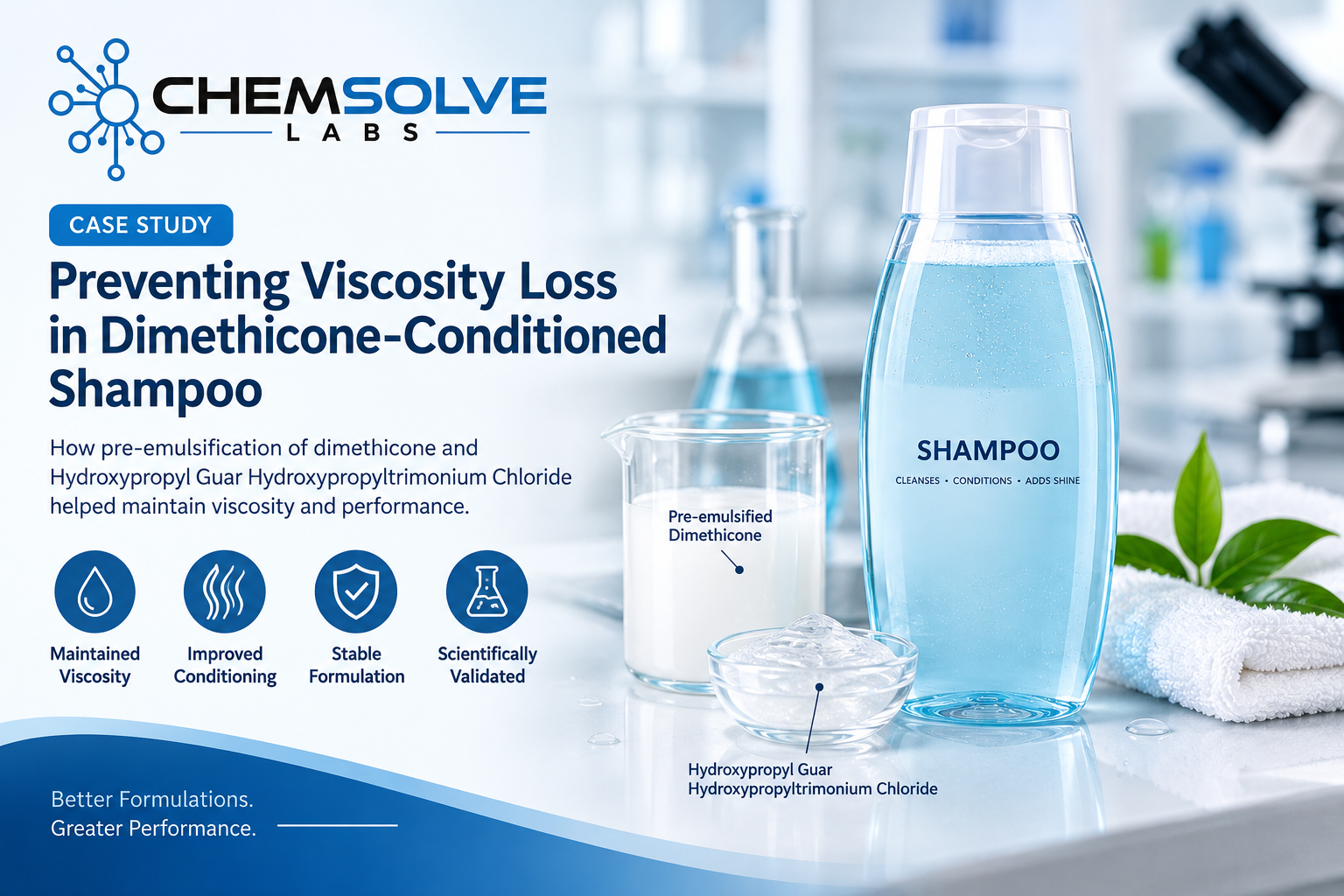
This case study investigates the possible causes of viscosity loss during the incorporation of dimethicone into a shampoo and describes a practical solution involving pre-emulsification and the use of Hydroxypropyl Guar Hydroxypropyltrimonium Chloride as a conditioning and rheology-supporting polymer.
2. Problem Statement
During shampoo development, the addition of dimethicone conditioner caused a noticeable decrease in the viscosity of the shampoo base. The reduction in thickness affected the product's desired consistency and potentially its consumer appeal and physical stability.
The objective was to incorporate dimethicone successfully while maintaining acceptable shampoo viscosity, uniformity, and conditioning performance.
3. Scientific Explanation of Viscosity Loss
Several mechanisms may explain why adding dimethicone reduces shampoo viscosity. # A. Disruption of the Surfactant Micelle Structure
Shampoos commonly contain anionic surfactants, such as Sodium Laureth Sulfate (SLES), often combined with amphoteric surfactants such as Cocamidopropyl Betaine.
These surfactants form micelles in water. Depending on the surfactant system, concentration, electrolyte content, and other formulation variables, the micelles can grow into elongated structures that contribute to viscosity.
When dimethicone is introduced, it may alter the organization and interactions of the surfactant micelles. This can reduce the effectiveness of the existing thickening mechanism, resulting in a thinner shampoo.
The extent of this effect depends on the surfactant system and the type and concentration of silicone used.
B. Incompatibility Between Dimethicone and the Aqueous Shampoo Base
Dimethicone is hydrophobic and does not dissolve directly in water. It therefore requires a suitable delivery system to distribute it uniformly throughout an aqueous shampoo.
If un-emulsified dimethicone is added directly, it may form large droplets or localized silicone-rich regions. These regions can interfere with the uniform structure of the shampoo and may contribute to viscosity changes, uneven distribution, or separation.
C. Interaction with the Existing Thickening System
Many shampoos rely on salt thickening, polymeric thickeners, or surfactant micelle structure to achieve their desired viscosity. Adding a silicone ingredient can change the balance of these systems. The effect may be especially noticeable in formulations that are already close to the maximum viscosity achievable through electrolyte thickening. Consequently, a shampoo that initially has an acceptable viscosity may become thinner after the addition of dimethicone.
4. Corrective Action: Pre-Emulsification of Dimethicone
The first corrective measure was to pre-emulsify the dimethicone before incorporating it into the shampoo.
Pre-emulsification involves dispersing the silicone into a suitable aqueous or compatible carrier system using an appropriate emulsifier or silicone-emulsion technology. The exact procedure depends on the dimethicone grade and the emulsifier system.
This approach offers several potential advantages: • Improves silicone distribution throughout the shampoo. • Reduces the risk of large silicone droplets and localized concentration differences. • Can improve the uniformity of the finished product. • May reduce formulation disturbances associated with adding neat silicone directly. • Can support more consistent conditioning performance. An important distinction is that pre-emulsification does not automatically prevent viscosity loss. The emulsifier and other ingredients in the pre-emulsion can also influence the shampoo's rheology. Therefore, the complete pre-emulsion should be evaluated in the final formulation.
5. Secondary Corrective Action: Hydroxypropyl Guar Hydroxypropyltrimonium Chloride
The second corrective measure was the use of Hydroxypropyl Guar Hydroxypropyltrimonium Chloride. This ingredient is a cationic, modified guar gum commonly used as a conditioning polymer in shampoos and other rinse-off hair-care products. # Mechanism of Action
The polymer hydrates in the aqueous phase and can contribute to the rheological properties of the formulation, depending on its grade, concentration, hydration conditions, and interactions with other ingredients.
Its cationic groups also provide affinity for negatively charged surfaces, including hair fibers. During shampoo application, this can help improve conditioning, wet combability, and hair feel.
In a suitable shampoo system, the polymer may contribute to viscosity and help maintain the desired product consistency after dimethicone incorporation.
However, it is important to distinguish between its two functions: 1. Conditioning: Improving hair feel, softness, and combability. 2. Rheology support: Contributing to viscosity or consistency under suitable formulation conditions.
Hydroxypropyl Guar Hydroxypropyltrimonium Chloride should not be considered a universal thickener. Its viscosity contribution depends on the polymer grade, surfactant composition, electrolyte level, pH, and processing conditions.
6. Discussion
The observed viscosity reduction is consistent with a possible interaction between the silicone delivery system and the shampoo's existing rheology. Direct addition of hydrophobic dimethicone can produce an uneven dispersion, while the emulsifier system and silicone droplets may affect the structure of surfactant micelles.
Pre-emulsification addresses the silicone-dispersion challenge by introducing the dimethicone in a more controlled form. Adding Hydroxypropyl Guar Hydroxypropyltrimonium Chloride provides a second strategy that can support conditioning and, under appropriate conditions, contribute to the viscosity of the aqueous system.
Nevertheless, the exact mechanism should be confirmed experimentally. Without viscosity measurements, microscopy, and the complete ingredient compositions, it is not possible to conclude that micelle disruption or poor silicone dispersion was the sole cause.
It is also necessary to verify that the polymer does not adversely affect foam quality, clarity, rinsing, silicone deposition, or long-term stability.
9. Conclusion
The viscosity loss observed after adding dimethicone conditioner highlights an important challenge in silicone-containing shampoo development. The most likely causes include changes in surfactant micelle structure, incompatibility between the silicone delivery system and the shampoo base, and interactions with the existing thickening system.
Pre-emulsifying dimethicone can improve its distribution and reduce problems associated with direct silicone addition. Hydroxypropyl Guar Hydroxypropyltrimonium Chloride can provide conditioning benefits and may help support viscosity in a compatible formulation.
The combined approach is a promising corrective strategy, but its effectiveness should be confirmed through controlled comparative testing, viscosity measurements, and stability evaluation.